
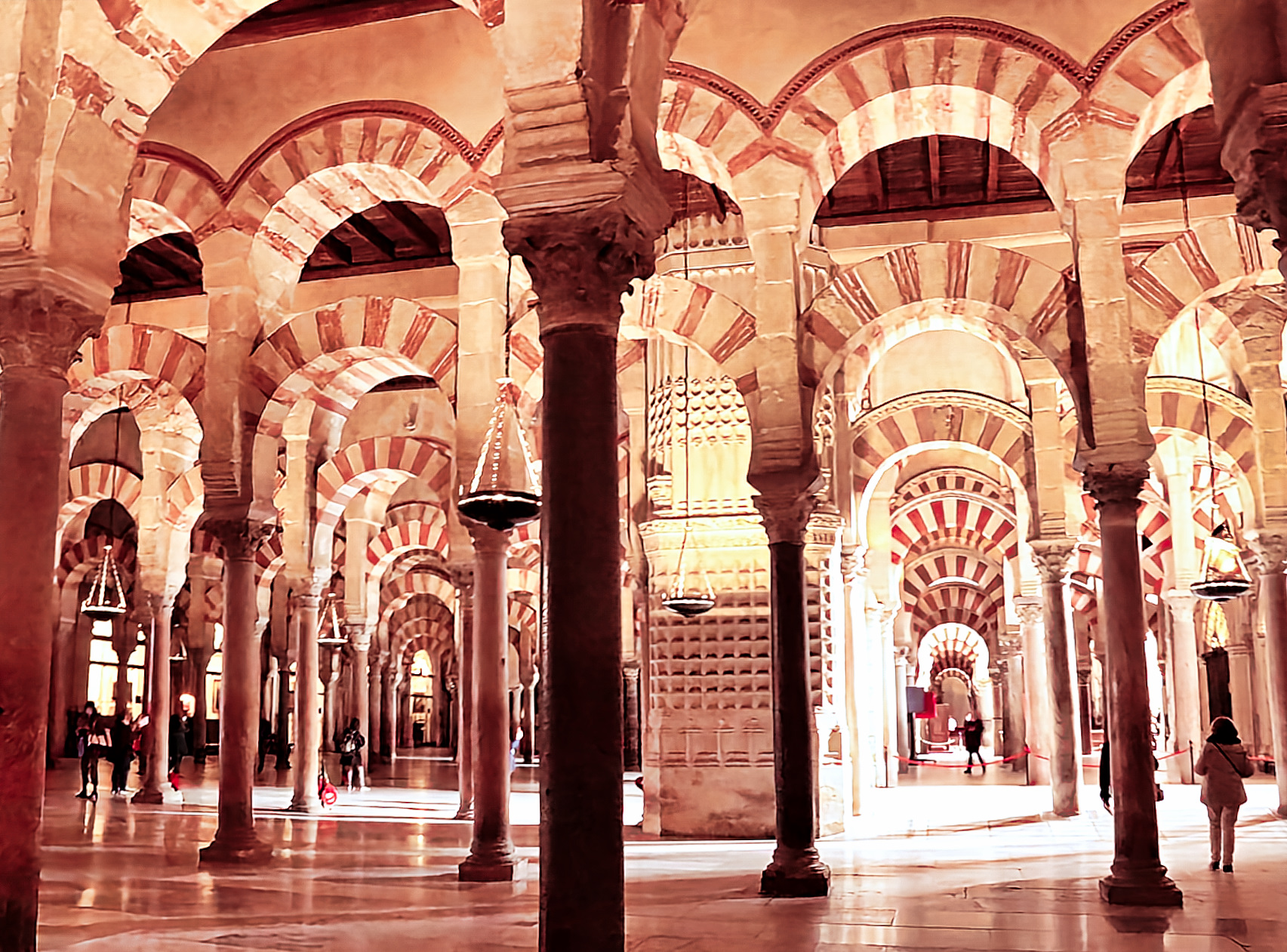
The Mihrab and the Choir: Learning to Honor Opposing Sacred Spaces
The Mezquita-Cathedral is ultimately defined by its tension, n’est-ce pas?
Think about it: On one side, you have the Mihrab, that exquisite, ornate shell built into the qibla wall, marking the sacred direction of Mecca. It’s the original, silent focal point for an infinite hall. On the other side—right in the centre—is the towering Christian High Altar and Choir, a magnificent structure demanding its own kind of attention.
These are not just two decorations; they are two absolute centers of gravity, two supreme sacred spaces, standing within the very same stone walls.
For those of us with a keen eye, the Córdoba Mezquita really shows us how different ideas can coexist. In our world, where everyone’s quick to pick sides, we really need to learn how to appreciate two completely different, but equally true, things without feeling like we have to choose one or destroy the other.

The Power of Opposite Focal Points
The architects here—whether through deliberate choice or historical necessity—have shown us that a building can house two supreme, non-negotiable truths. It holds the infinite horizontal plane of the mosque and the dramatic vertical height of the cathedral. It holds the empty prayer niche facing one direction and the consecrated Eucharist facing another.
The genius of this space is that it doesn’t try to resolve the conflict; it simply contains it. And in that containment, there is a profound peace. We aren’t being asked to choose a single center; we are being asked to widen our peripheral vision to honour both sacred intentions.
The Psychology of Complexity
This is the lesson we must import from stone to soul.
We often feel the need to create one main “sanctuary” in our minds—a single political view, one clear truth about an event, or one simple feeling about a relationship. But living a full, meaningful life—and understanding a complex world—requires us to hold space for two opposing Mihrabs.
Perhaps it’s holding the deep love for a person alongside the profound disappointment they caused. Or honouring a cherished tradition while embracing a necessary, progressive change. Most of the world’s conflict comes from the failure to tolerate dual centres of gravity. We fear that honouring the Mihrab means destroying the Choir.
But the Mezquita shows us that to be truly whole, to achieve that profound, rare peace, we must allow both centers to remain equally sacred. We must permit the two truths to stand, in tension, without demanding a winner.
Your soul’s architecture, like the Mezquita’s, is richer for its contradictions. Your life isn’t a simple equation; it’s a magnificent, complex synthesis.

Your Center of Gravity
This is a beautiful and challenging way to see the world, non? It requires a deliberate choice to resist easy answers.
Where in your own life—in your relationships, your politics, or your personal beliefs—are you being asked to honour two opposing sacred spaces? Which “Mihrab” and “Choir” are currently demanding your attention?
Share your reflections with me. Let’s discuss how we can all cultivate a more complex, peaceful sanctuary within ourselves.
Leave a Reply