The boat trip from Marseille, Genoa, or Valencia in the 1700s wasn’t a holiday. It was a brutal, terrifying trial.
You were packed onto a wooden galley, smelling of salt, sweat, and cheap tallow. You were sick for days, terrified of Barbary pirates, and praying every time the Mediterranean turned grey and violent. You were a pilgrim—leaving behind your home in France, Spain, or Italy—walking and sailing toward Jerusalem, with Malta standing as the great, sun-baked stepping stone in the middle of the sea.
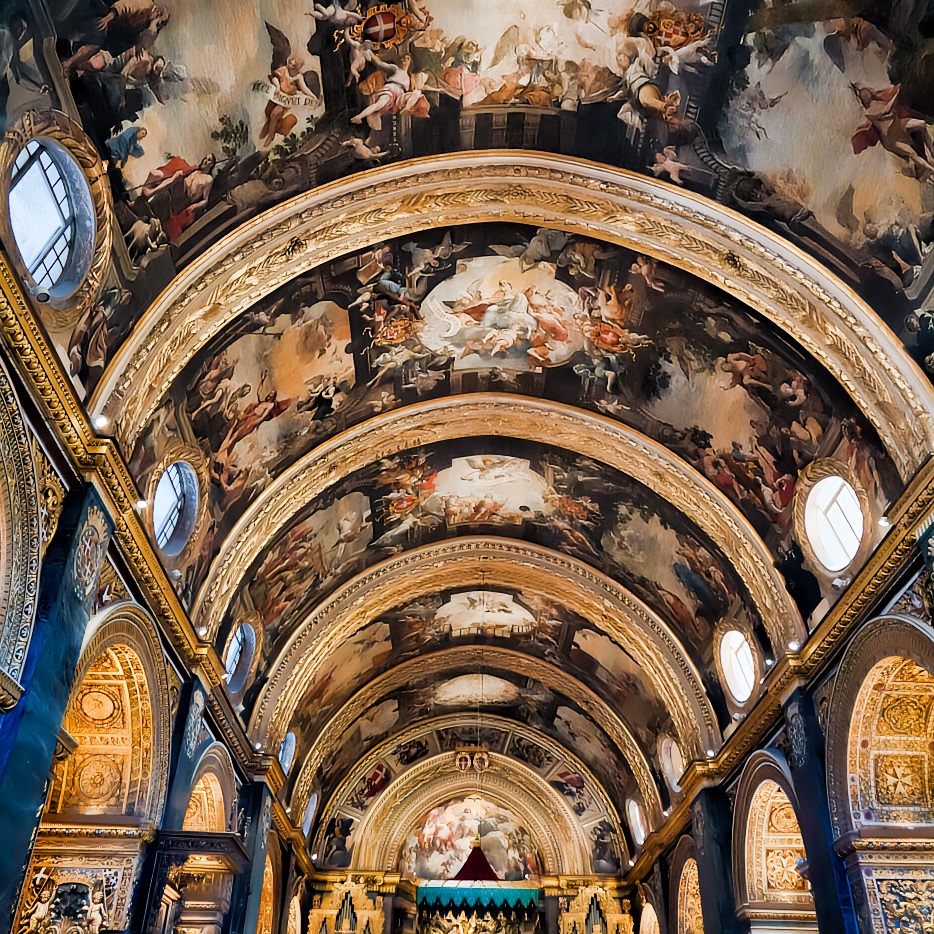
When those travellers finally dragged their exhausted, salt-crusted bodies up the limestone steps of Valletta and pushed open the doors of St. John’s Co-Cathedral, what they saw must have felt like a tear in the fabric of the universe.
Gold, Bone, and the Salt-Crusted Soul: What St. John’s Teaches Us About Modern Seeking
From the outside, St. John’s looks like a fort. It’s yellow limestone, austere, heavy, and defensive—built by the Knights Hospitaller who knew a thing or two about siege warfare.
But step inside, and the world explodes.
It is a blinding, dizzying riot of High Baroque gold, carved stone, and light. After weeks of brown canvas, dark seas, and gray wooden decks, a 18th-century pilgrim didn’t just see the opulence; they felt it hit their nervous system like a physical blow. It was designed to feel like stepping straight out of the purgatory of the road and into the Heavenly Jerusalem.
The Floor of Skulls: Dancing on the Memento Mori

As a student of world religions and archetypes, I didn’t look up at the gold ceiling first. I looked down.
The entire floor of the cathedral is made of nearly 400 marble tombstones. But these aren’t solemn, boring slabs. They are intricate, colourful marble marquetry—a vivid, dancing tapestry of skeletons, skulls, scythes, crowns, and heraldic shields.
To the modern eye, it looks macabre, maybe even dark. But to the 1700s pilgrim, this was the ultimate symbol of equality: The Memento Mori.
Underneath those stunning tiles lie the Grand Masters and the noble Knights of St John. Men who had untold wealth, noble blood, and massive power. Yet, their graves are paved over with skeletons holding hourglasses. The message on the floor was crystal clear to the weary traveller standing on top of them:
- King or peasant, knight or beggar—we all end up as bones beneath the marble.
The gold above promised eternal light, but the floor below reminded you to keep your ego in check. It was a brilliant psychological balance of grandiosity and humility.
Caravaggio’s Dark Shadow in the Golden Room

Tucked away in the Oratory sits Caravaggio’s masterpiece, The Beheading of Saint John the Baptist.
If the rest of the church is a choir of Baroque gold screaming about the glory of God, Caravaggio’s canvas is the heavy, silent shadow in the corner. It is huge, dark, and brutal. He didn’t paint a heroic, glowing martyrdom; he painted a messy, cold execution in a courtyard.
Caravaggio—a man on the run, a murderer, a deeply flawed human carrying his own massive internal shadow—signed his name in the red paint dripping from Saint John’s neck. It’s the only painting he ever signed.
For the pilgrim, standing in front of that massive canvas was a reminder that holiness doesn’t mean life is clean or easy. Violence, tragedy, and human dark sides exist even in the most sacred spaces. Caravaggio painted the reality of the human condition right in the heart of the Knights’ gold.
What Can We Learn from the Pilgrimage Today?
We live in a world where everything is frictionless. We book a flight on an app, we skip the lines, we swipe through photos of places before we even arrive, and we complain if the Wi-Fi is slow. We have speed, but we’ve lost the journey.
The 18th-century pilgrim needed the brutality of the sea journey to appreciate the gold of St. John’s. The contrast is what created the awe.
- The Value of the Struggle: Awe isn’t free. You can’t hack it or shortcut it. When we skip the hard, uncomfortable travel—whether it’s a physical journey or the slow, painful work of grief and self-reflection—the “destination” loses its power to heal us.
- Remembering the Floor: In our modern society, we spend so much energy trying to look like the gold ceiling—building our “brands,” accumulating wealth, and curating perfect lives. We need to look down at the “floor of skulls” more often. Not to be morbid, but to remember that our time is short, our egos are fragile, and we are all walking each other home on the same marble floor.
- Seeking the Sanctuary: The pilgrims didn’t go to Malta just to see a building. They went to be changed. They went to lay down the heavy pack they’d been carrying across Europe and find a moment of grace.
Standing in the quiet heat of Valletta today, camera in hand, I realised that we are all still those sea-sick travellers. We are all looking for a space that feels bigger than our small, frantic days—a place where the gold and the shadow sit together in peace.


Leave a Reply